


Curelle™ Vascular Reset Stick
Curelle™ Vascular Reset Stick
If you are tired of red marks that won't fade no matter what you try, then one pass of Curelle™ — the only leave-on stick that uses onion-bulb flavonoids to calm the dilated capillaries behind PIE — is exactly what your skin has been missing.
🪞 Skip the morning mirror zoom-in
💄 Stop reaching for concealer every day
🔬 Treats the vessels, not the pigment
🛡️ Redness fades in 8 weeks, or it's free
Couldn't load pickup availability

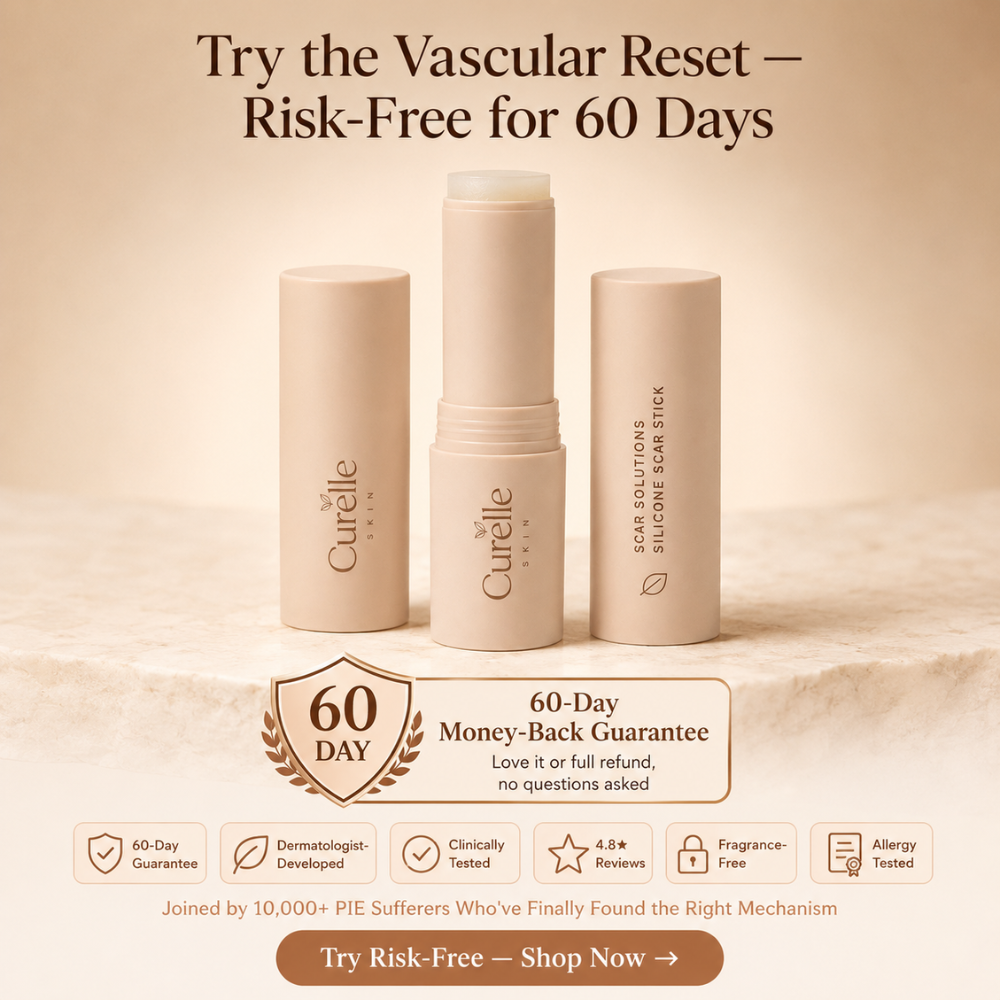
Visible redness reduction in 8 weeks — or it’s free.
If the PIE marks you’ve managed for years aren’t measurably less red after 8 weeks of consistent use, send it back for a full refund. No forms. No photographs. No explanation required.

Curelle™ Vascular Reset Stick
Description
Description
Curelle™ works by giving your skin what every other product missed: a formula built to reach the dilated capillaries behind PIE, not sit on the pigment above them. Its onion-bulb flavonoids — quercetin and kaempferol — act on histamine-1 signaling at the vascular layer, prompting the over-dilated capillaries that keep the marks red to slowly constrict. Held under a silicone seal, they stay in contact with the skin for hours, not the twenty minutes a serum lasts before it evaporates. The redness eases at the source, not under makeup. It works because it's reaching the layer where PIE actually lives — the vessels — not the melanin layer where every product you've tried was aimed. No pigment-fading. No serum that flashes off before it can work. No covering it up and calling it progress. Just one pass on clean skin, working at the only depth where red marks actually fade.
How long until I see results?
How long until I see results?
Most people feel the surface redness calm within the first day or two — that's the fast-acting part. The PIE marks themselves fade more gradually: visible change typically shows between weeks three and eight of consistent use, since constricting dilated capillaries is a slower process than fading pigment. The timeline above shows exactly what to expect at each stage — and the 8-week guarantee is set to match it.
Shipping info
Shipping info
Processing Time: Orders ship within 1-3 business days.
Delivery Time: Estimated delivery is 5-12 business days depending on location.
Tracking: A tracking number will be emailed once your order is dispatched.
Need help? Contact us at support@curelle.store


So nice to carry around and put on my fresh scar several times a day — it helped the redness within a day or two.
The breakouts cleared.
The red marks didn’t.
Every morning starts the same way — at the mirror, checking whether your face still looks like it’s breaking out.
The morning verdict
Bathroom mirror first, then the window, then the phone camera — zooming in before you’ve had coffee, calculating how much coverage today needs. It isn’t hopeful. It’s a daily damage check that sets the tone for the whole day.
Concealer isn’t a choice
Green corrector under full foundation — even for a work-from-home day, because the marks read as active acne on a video call. The day you started skipping it on weekends felt like a milestone, and that tells you everything.
Tried everything, same result
Years of serums, acids, and dermatology visits that did so little you scrapped your original plan. “I’ve tried everything and they all heal the same as when I don’t use them.” Each one abandoned around week three — each one deepening the fear that your skin just doesn’t respond.
You’re not chasing perfect skin. You just want to stop thinking about it.
You diagnosed it right.
The products were built for the wrong problem.
Vitamin C that sat on top and evaporated in twenty minutes. AHAs and acids that seemed to make your skin worse, not better. Dermatology visits that did so little you scrapped your original plan. Mederma, Bio-Oil, the whole shelf. You did the research most people never do — you even worked out that your redness is PIE, not PIH. And still, everything healed “the same as when I don’t use them.”
Every one of those targets pigment. PIE isn’t pigment.
PIE redness is vascular — capillaries under the healed surface that dilated during the breakout and never contracted. Vitamin C, AHAs, retinol, brighteners: every one of them targets melanin, the pigment pathway. None has any route to a dilated blood vessel. It was the right effort aimed at the wrong biology — which is exactly why a correct diagnosis still produced no result.
The Flavonoid
Vascular Reset
Why the redness won’t fade
PIE is persistent capillary dilation beneath the healed skin — a vascular state, not a stain sitting on top. Until something acts on the vessels themselves, the color stays. Nothing you’ve tried had a pathway to the capillary level.
Why serums and acids couldn’t work
They target melanin and surface texture, and most evaporate within twenty minutes of contact. A pigment ingredient on a vascular problem can’t reach the mechanism — and brief surface exposure can’t sustain action even if it could.
What acts on the vessels
The Flavonoid Vascular Reset delivers quercetin and kaempferol — flavonoids from fermented onion bulb — that suppress histamine-1 signaling and capillary permeability, prompting the dilated PIE capillaries to constrict. Held under a sustained silicone seal, they stay in contact for hours per application instead of minutes, so the vascular action continues through the day. Bisabolol calms the surface redness on top.
Putting Vitamin C on PIE is like treating a bruise with whitening cream. A bruise is blood vessels. Whitening cream targets pigment. You were given excellent products — for the wrong problem.
From a daily verdict
to background noise
The shift people describe once something finally acts on the vessels — not the pigment.
Skip the concealer
The marks fade to where corrector stops being step one of every morning. In their words: “I started skipping concealer on weekends.”
Walk into any light
Overhead fluorescents, store mirrors, and ring lights stop running the room. As one buyer put it: “I walked past a mirror with awful lighting and didn’t immediately panic.”
Stop zooming in
The first thing you do every morning stops being a damage check. “I no longer zoom in on them immediately — that mental shift alone is life-changing.”
Hope that holds
For the first time the trajectory points down instead of sideways. The line people reach: “I finally have hope for good skin for the first time in my life.”
You diagnosed it right.
The products were built for the wrong problem.
Vitamin C that sat on top and evaporated in twenty minutes. AHAs and acids that seemed to make your skin worse, not better. Dermatology visits that did so little you scrapped your original plan. Mederma, Bio-Oil, the whole shelf. You did the research most people never do — you even worked out that your redness is PIE, not PIH. And still, everything healed “the same as when I don’t use them.”
Every one of those targets pigment. PIE isn’t pigment.
PIE redness is vascular — capillaries under the healed surface that dilated during the breakout and never contracted. Vitamin C, AHAs, retinol, brighteners: every one of them targets melanin, the pigment pathway. None has any route to a dilated blood vessel. It was the right effort aimed at the wrong biology — which is exactly why a correct diagnosis still produced no result.
The Flavonoid
Vascular Reset
Why the redness won’t fade
PIE is persistent capillary dilation beneath the healed skin — a vascular state, not a stain sitting on top. Until something acts on the vessels themselves, the color stays. Nothing you’ve tried had a pathway to the capillary level.
Why serums and acids couldn’t work
They target melanin and surface texture, and most evaporate within twenty minutes of contact. A pigment ingredient on a vascular problem can’t reach the mechanism — and brief surface exposure can’t sustain action even if it could.
What acts on the vessels
The Flavonoid Vascular Reset delivers quercetin and kaempferol — flavonoids from fermented onion bulb — that suppress histamine-1 signaling and capillary permeability, prompting the dilated PIE capillaries to constrict. Held under a sustained silicone seal, they stay in contact for hours per application instead of minutes, so the vascular action continues through the day. Bisabolol calms the surface redness on top.
Putting Vitamin C on PIE is like treating a bruise with whitening cream. A bruise is blood vessels. Whitening cream targets pigment. You were given excellent products — for the wrong problem.
From a daily verdict
to background noise
The shift people describe once something finally acts on the vessels — not the pigment.
Skip the concealer
The marks fade to where corrector stops being step one of every morning. In their words: “I started skipping concealer on weekends.”
Walk into any light
Overhead fluorescents, store mirrors, and ring lights stop running the room. As one buyer put it: “I walked past a mirror with awful lighting and didn’t immediately panic.”
Stop zooming in
The first thing you do every morning stops being a damage check. “I no longer zoom in on them immediately — that mental shift alone is life-changing.”
Hope that holds
For the first time the trajectory points down instead of sideways. The line people reach: “I finally have hope for good skin for the first time in my life.”
It targets a different layer
than everything you’ve tried
The products that failed you weren’t bad products. They were built for pigment. This is built for vessels.
for PIE
← Scroll to compare →
Same effort. Same diligence. A different layer of the skin.
Three steps to fade
redness at the source
On healed skin, the routine takes under a minute — and the more often you do it, the more continuous the work.
Massage onto the marks
Gently massage a generous layer onto clean, dry skin over the red marks. The massage motion is part of the delivery, not separate from it.
Follow with sunscreen
Always finish with SPF during the day. Sun exposure keeps vascular redness lit up and quietly undoes your progress.
Reapply through the day
Reapply 3–5 times a day for 8–12 weeks. Because it deposits and seals rather than evaporating, each pass keeps the flavonoids in contact with the skin.
For PIE on healed, intact skin — not over open or active breakouts. If skin is broken, wait until it’s fully closed.
Visible redness reduction in 8 weeks — or it’s free.
Use it the way it’s meant to be used: a generous layer on clean, healed skin, several times a day, through the window.
If you don’t see visible redness reduction within 8 weeks of consistent use — not perfect skin, just measurable change in the PIE marks you’ve been managing for years — send it back for a full refund.
No forms. No photographs. No explanation required.
We can promise this because the mechanism finally matches your problem: it acts on the dilated vessels causing the redness, not the pigment every other product was built for.
You’ve done the research. This time the only thing you’re risking is the redness.
— The Curelle team
The things mechanism-
minded buyers ask first
If you’ve already worked out that your marks are PIE and nothing has touched them, these are the answers that matter most.
Because everything sold for post-acne redness targets pigment — melanin. PIE isn’t pigment; it’s dilated capillaries under the surface. This is the first stick built around quercetin and kaempferol, flavonoids that act on capillary permeability rather than melanin. You weren’t using the wrong amount of effort — you were handed the wrong biology.
PIH is pigment: the brown or dark marks left after a breakout. PIE is vascular: the red or purple marks from capillaries that dilated and never contracted. Brightening products treat PIH. This is built for PIE — the red marks that don’t respond to anything designed to fade dark spots.
A damaged barrier doesn’t mean unresponsive skin — it means prior products added irritation to vascular tissue. This has no acids or actives. It’s pH-stabilized, allergy-tested, and fragrance-free, formulated for skin that’s already compromised. The mechanism works on the vessels without stressing the surface.
The silicone here isn’t doing the fading — it’s the delivery system. It forms a sustained seal that keeps the flavonoid stack in contact with your skin for hours instead of the twenty minutes a serum lasts. The flavonoids do the vascular work; the silicone just makes sure they stay where they’re needed.
That’s exactly the problem it’s built around. A serum sits on top and flashes off; this deposits under an occlusive seal that holds the actives in contact through the day. Applied 3–5 times, the vascular ingredients stay at the site instead of evaporating before they can work.
Surface redness can ease early, but visible fading of the PIE marks builds over 8–12 weeks of consistent use. It’s progressive, not sudden — and the guarantee is set at 8 weeks for exactly that reason. The single biggest variable in the outcome is consistency, not your skin.
Still deciding? The 8-week promise means the only thing you risk is the redness.