


Curelle™ Scar Healing Stick
Curelle™ Scar Healing Stick
If you've tried silicone before and watched it peel off against your clothes and sheets, then one swipe of Curelle — the only silicone format that deposits a continuous seal instead of sticking one on — is exactly what your healing window needs.
✂️ Stays on through clothing, sleep, and movement
🩹 One continuous seal — nothing to peel off
🔬 60% silicone — the strength your surgeon meant
🛡️ Softer, flatter, less red in 8 weeks — or it's free
Couldn't load pickup availability

Curelle™ Scar Healing Stick

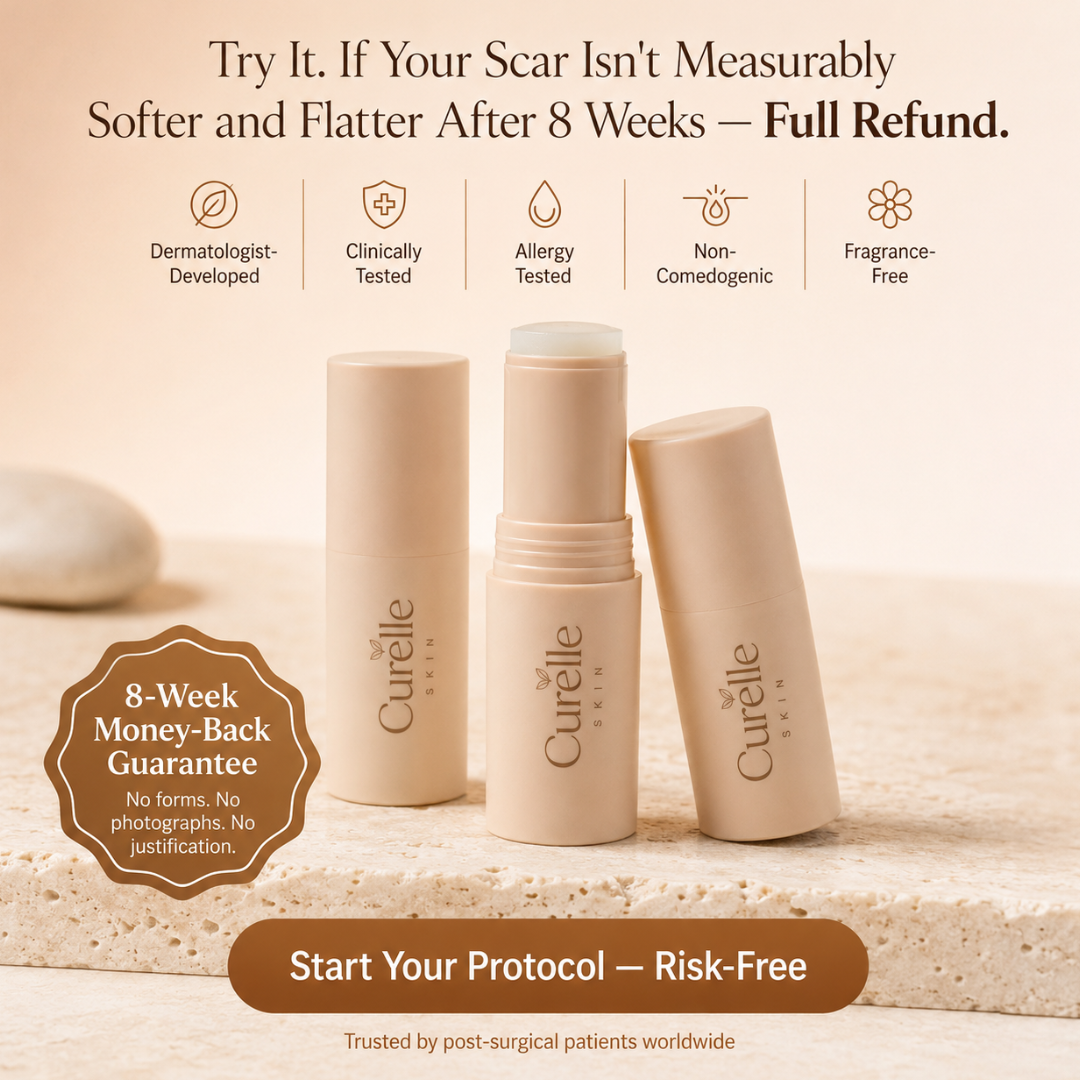
Softer, flatter, less red — or it’s free.
If your scar isn’t measurably softer, flatter, and less red after 8 weeks of daily use, return it for a full refund. No forms. No photographs. No justification required.
Description
Description
Curelle gives your scar what the healing window needs: continuous contact. The 60% silicone deposits a soft, unbroken film that stays put through clothing, sleep, and movement — keeping the moisture-pressure signal your tissue needs to reorganize itself flat and soft instead of raised and red. And because you massage it on, the application works the tissue at the same time. One swipe, several times a day, through the only window where scar minimizing is possible.
How long until I see results?
How long until I see results?
Most people feel the pulling and itching ease within the first day or two — early confirmation the seal is working. Visible change follows in phases: redness softens over the first two weeks, the scar begins to flatten through the first month, and color and texture keep normalizing through months two and three. The timeline above shows exactly what to expect at each stage. Staying consistent through the full window is what determines how far it goes.
Shipping info
Shipping info
Processing Time: Orders ship within 1-3 business days.
Delivery Time: Estimated delivery is 5-12 business days depending on location.
Tracking: A tracking number will be emailed once your order is dispatched.
Need help? Contact us at support@curelle.store


8 weeks post-op. My scars are soft and healing well — and my plastic surgeon is happy with the results.
The surgery is over.
The reminder isn’t.
Every morning at the mirror, you check the scar — and get pulled back to the day it happened.
The morning pull
You’re grateful they’re there — but they’re a reminder of lots of raw emotions. You touch the scar, check if it’s healing right, and the medical memory ambushes you alongside the hope.
The strip that fell off
You tried the silicone strips, but they would fall off from rubbing against clothing or sheets. Every day it’s off is a day the protection isn’t working — and the window won’t wait.
Still coming to terms
You’re terrified the mark will be permanently visible. You’re still coming to terms with what your body went through — and you have one job now: minimize what’s left, while the window is open.
You’re in the window right now — and you can’t wait to see the change.
Silicone is the right answer.
The format kept failing you.
You tried the silicone strips — and they fell off from rubbing against clothing or sheets. You tried a roll of tape silicone, but to be honest, you never really did, because it was very inconvenient. And peeling off silicone scar tape is uncomfortable. The mechanism was never the problem. The delivery was.
A seal that breaks every time your body moves isn’t a seal
Every silicone format that relies on adhesion breaks contact the moment clothing shifts, a bra strap sits against it, or sleep rotation happens. And every break in contact is a break in the moisture-pressure signal the scar tissue needs to reorganize. A 12-hour application that’s actually present for six isn’t a 12-hour treatment — it’s six hours of contact and the rest of the day uncovered.
The Continuous
Occlusion Seal
Why the scar isn’t finished
The scar tissue reorganizes only while the moisture-pressure signal stays unbroken. Duration is the variable — not whether silicone touched the skin at some point, but whether it stayed in contact. Any format that depends on adhesion can’t guarantee that contact.
Why sheets and tape couldn’t hold
Sheets and tape are adhesion-dependent. When the adhesion goes, the seal goes — and the scar spends most of the day uncovered. They also deliver passive contact only: they can’t put pressure on the tissue the way active treatment can.
What holds through your real life
The stick deposits an unbroken silicone film that’s held by the 60% formula’s topical deposit — not adhesion — so it re-establishes with every application and holds through movement in between. The application motion delivers calibrated mechanical pressure to the collagen matrix at the same time: two processes active with every use. Because the seal doesn’t depend on your body staying still, it keeps the window open for the full time it’s supposed to be open.
A silicone sheet on a moving body is like a bandage that falls off every time you bend your arm. You wouldn’t say bandages don’t work. You’d say you need one that holds through movement.
From a daily reminder
to nearly invisible
The outcomes people describe once the seal finally stays continuous.
Nearly invisible
The scar fades flat, soft, and pale — until it no longer leads the room. In their words: “My biopsy scar is nearly invisible.”
Flat and barely visible
Raised, purple, and angry settles down over the window. The outcome people work toward: “My scars are flat and barely visible.”
Soft and healing well
The pulling and itching of active healing eases within the first day or two, and the texture softens. As one buyer put it: “Scars are soft and healing well.”
Carry it, use it often
No peeling, no mess — the format finally lets you apply as often as the window asks. “So nice to carry around and put on my fresh scar several times a day.”
Written by people
healing surgical scars
silicone concentration — the clinical threshold behind “use silicone,” not a cosmetic-grade amount
“It’s definitely flattening.”
This is so nice to carry around and put on my fresh scar several times a day. It’s definitely flattening — and it helped the redness within a day or two.
“Nearly invisible.”
My biopsy scar is nearly invisible. My scars are flat and barely visible — I’m grateful they’re there, but they used to be a reminder of lots of raw emotions. Now the mirror is just a mirror.
Gentle enough for skin
that’s still healing
A fragrance-free, anhydrous formula made for the sensitivity of a recent post-surgical scar — tested for purity and suitable for all skin types.
One stick, one purpose: a 60% silicone seal with centella and bisabolol to soothe a fresh scar — laboratory tested for purity, and free of phthalates, parabens, PFAS, and benzophenone-3.
The difference is whether
it holds when you move
Same mechanism. A delivery that doesn’t depend on your body staying still.
| Compare | Curelle Stick |
Sheets & Strips |
Tape Roll |
|---|---|---|---|
| Holds through clothing, sleep & movement | |||
| Continuous contact, no adhesion to break | |||
| 60% silicone concentration | |||
| Mechanical massage with every application | |||
| Reapply anywhere — carry it in a bag | |||
| Centella + bisabolol to soothe a fresh scar | |||
| Comfortable — nothing to peel off |
Same silicone science. The stick is the only format that keeps the seal continuous through your real, moving life.
Three steps for a scar
that heals soft and flat
Once the wound is fully closed, the routine takes under a minute.
Massage onto the scar
Gently massage a generous layer onto clean, dry skin over the scar. The application motion is part of the treatment, not separate from it.
Follow with sunscreen
Always finish with sunscreen, especially on the face. Sun exposure is the one thing that keeps a healing scar dark.
Reapply through the window
Reapply 3–5 times a day for 8–12 weeks. Because it deposits rather than adheres, every application keeps the seal continuous.
Use once the wound is fully closed — not on open sutures. Consult your physician before use over post-surgical sutures.
Softer, flatter, less red in 8 weeks — or it’s free.
Use it the way it’s meant to be used: a generous layer on a clean, closed scar, several times a day, through the healing window.
If your scar isn’t measurably softer, flatter, and less red after 8 weeks of daily use, you get a full refund.
No forms. No photographs. No justification required. One email is enough.
We can stand behind this because the format finally solves the part that defeated you before — staying in continuous contact through your real, moving life, so the window stays open.
You’ve already done the hard part. Let this be the easy one.
— The Curelle team
The things people
want to know first
If you were told to use silicone and you’re trying to do this right, these are the answers that matter most.
Sheets and tape stay on by adhesion — so the moment a seatbelt, a bra strap, or your sheets rub against them, the seal breaks. The stick deposits a silicone film instead of sticking one on, so there’s no adhesion to fail. One application stays present through clothing, sleep, and movement, and you re-establish it whenever you reapply. The format solves the contact problem — it was never your discipline.
When a surgeon says “use silicone,” they’re pointing at a clinical concentration, not the lowest amount a product can legally carry. This stick is formulated at 60% silicone — the threshold used in scar-management settings. Plenty of retail silicone products sit well below that, which is exactly the gap that leaves people unsure they’re using the right thing.
Outcomes range from clearly improved to nearly invisible for suitable scars — and the main variable is consistency, not biology. The seal kept unbroken through the full window is what determines how far the scar settles. The ceiling is usually higher than people fear, as long as the contact stays continuous.
Use it 3–5 times a day for 8–12 weeks on a fresh, closed scar. Because it deposits rather than adheres, more applications simply keep the seal continuous — which is what the healing window needs. Carrying one in your bag and keeping one by the bed is how most people stay consistent.
Change comes in phases, not overnight. The pulling and itching tend to ease in the first day or two and redness softens over the first couple of weeks; flattening follows over the first month; color and texture continue to normalize through months two and three. Steady progress at the right time is the goal — not a sudden jump.
Use it once the wound is fully closed — not on open sutures. Check with your physician before using it over post-surgical sutures. After that, apply to clean, dry skin and follow with sunscreen, and you can use it on new scars, healed older scars, and post-procedure marks.
Still deciding? The 8-week promise means the only thing you risk is the scar.